Everything comes in.
Only what fits rises.
Agents scan 1900+ official sources a day and filter nothing on the way in. An AI audit reads every notice and scores the fit from 0 to 100: the noise sinks, anything unverified waits in To Confirm, and what rises lands in one pipeline, with the deadline on every row.
The day starts on one screen.
The command center opens on what matters this morning: how many relevant tenders are live, which of them fit strongly, what the tracked pipeline is worth and where it sits by region, with the top opportunities ranked underneath. It also shows when the last scan ran, whether the data audit passed, and when the next sweep begins. No portals, no tabs, one screen.
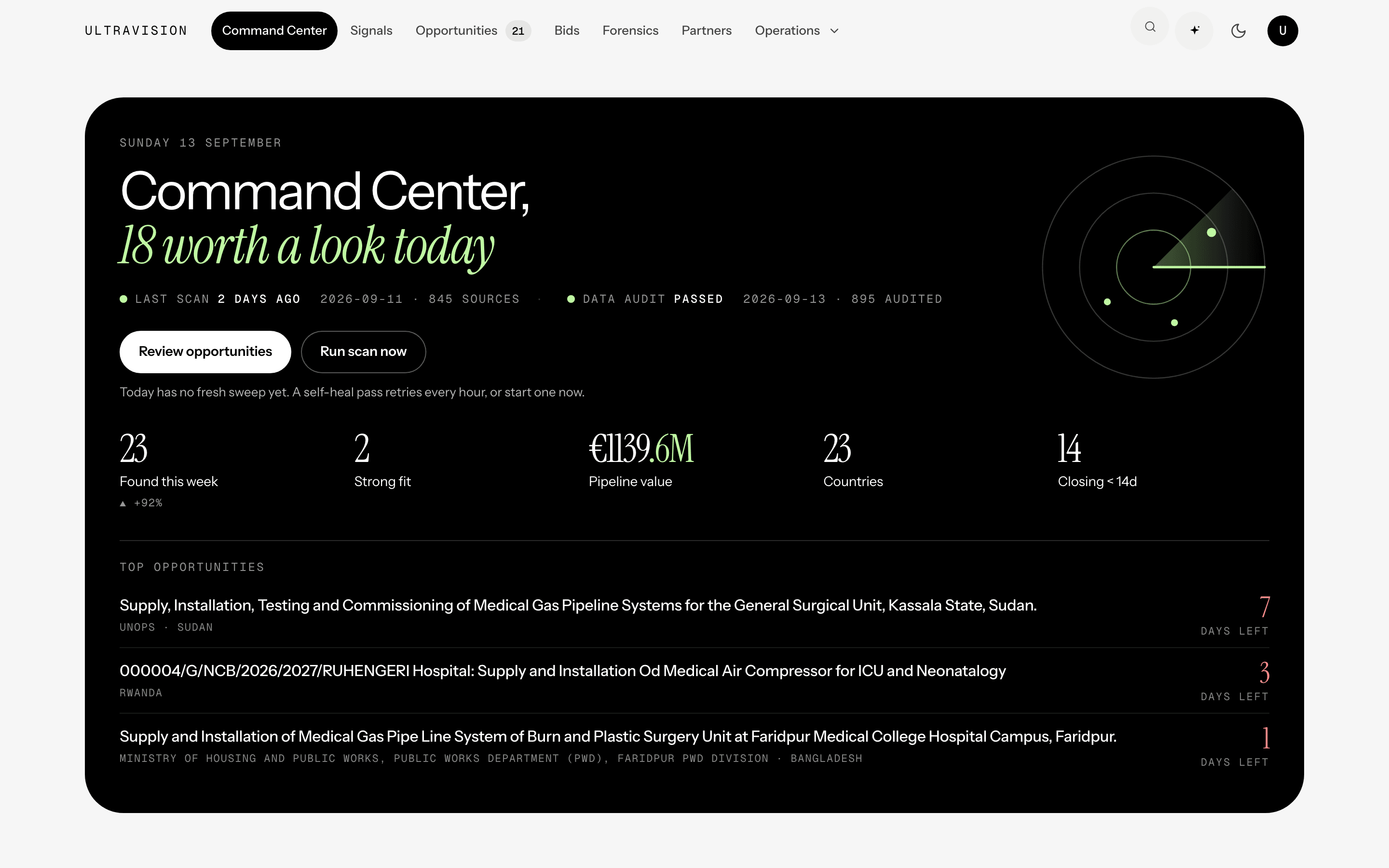 live workspace · command center
The command center of the live workspace, early July 2026: the day's relevant tenders, tracked pipeline value, regions, and the scan and audit status.
Explore the moduleEvery notice read and scored, 0 to 100.
The opportunities list holds open, unexpired tenders only. Every notice has been read against your profile and scored 0 to 100 for fit, with the noise scored down and pushed below the line. Deadlines sit on every row and closing-soon rises to the top. Anything that could not be verified against an official source waits in To Confirm, with the missing pieces listed, instead of polluting the list.
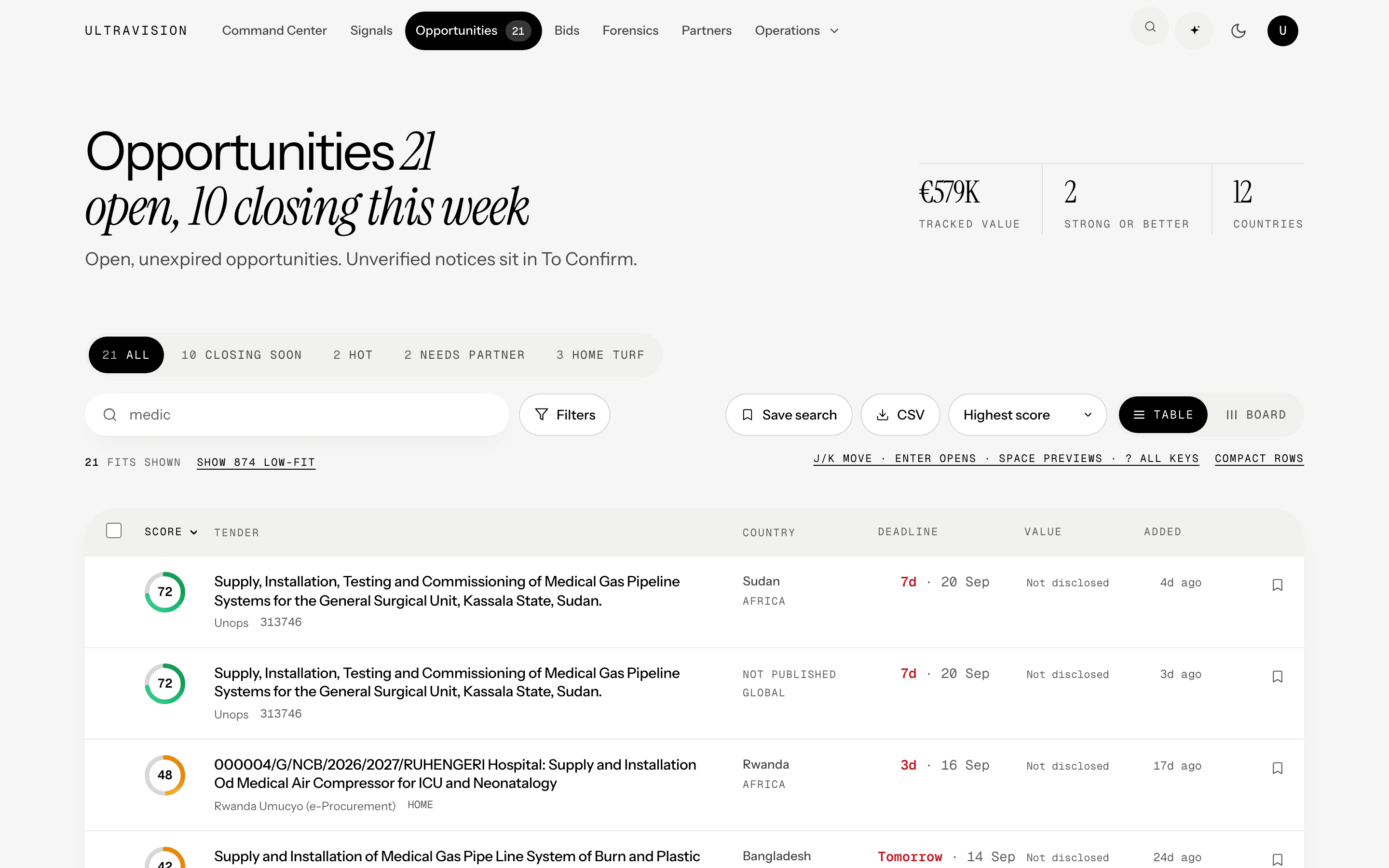 live workspace · opportunities
The scored list of the live workspace: a fit score and a live deadline on every row, with filters for home turf, aftermarket work and closing soon.
Explore the moduleOne page that reads the tender for you.
Open a tender and the reading is already done. An AI audit scores the fit and says why. A product match ledger maps the buyer's named requirements to your catalogue, line by line. The going rate and the win read are taken from real award history, not gut feel. A first draft of the bid is one click away, and your team's notes and bid status live on the same page.
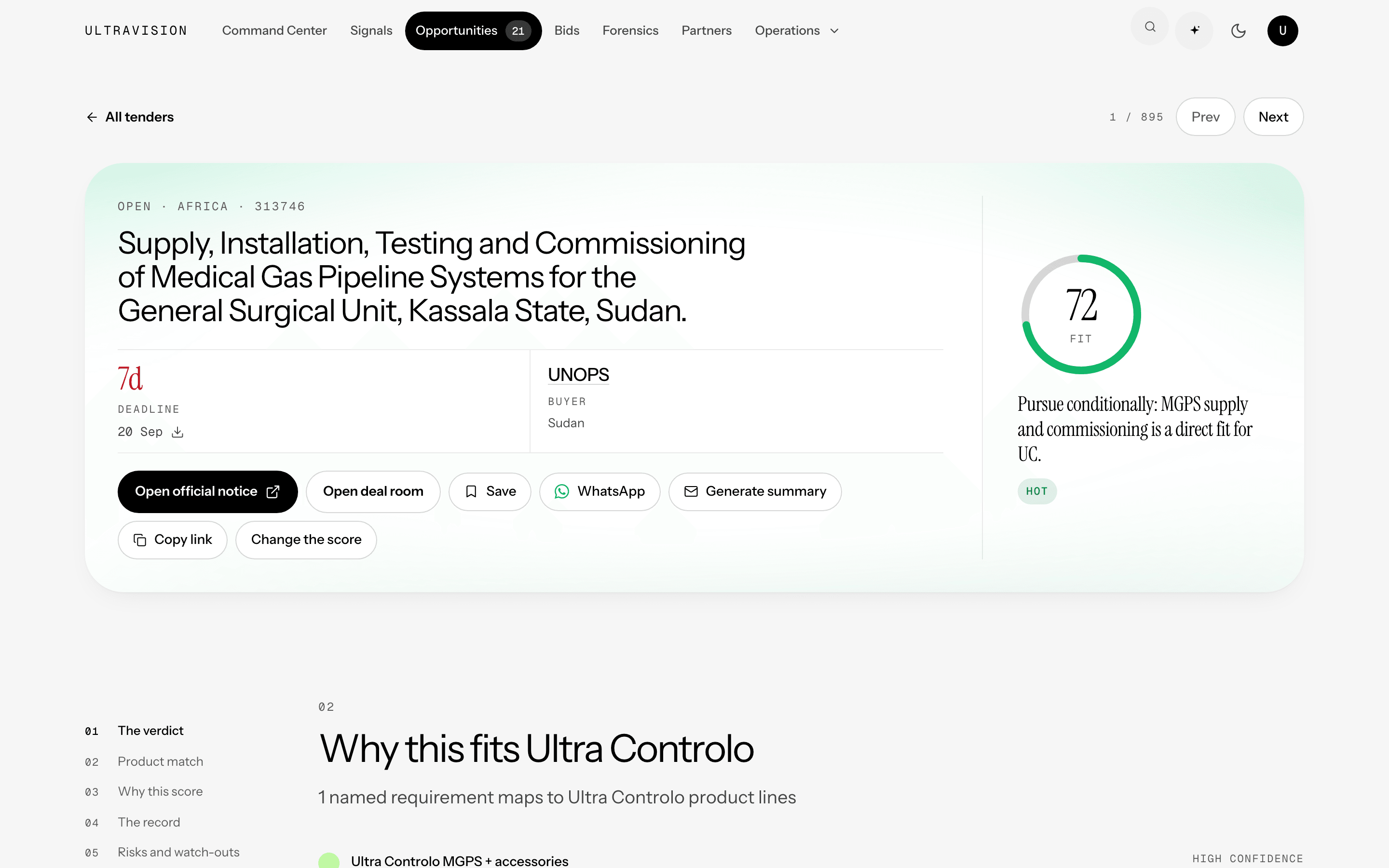 live workspace · tender view
A real tender page from the live workspace: the fit score with its reasoning, the product match ledger, one-click exports, and the bid status ladder.
Explore the moduleSignals, before the notice exists.
Most radars start when the tender publishes. Signals starts earlier: prior-information notices where a buyer has already signalled a purchase (they are optional, so not every purchase has one), and framework awards aging toward re-tender, each on its own requalification clock. You position before the field forms, and every signal is traced to its official source notice, so nothing on this screen is a rumour.
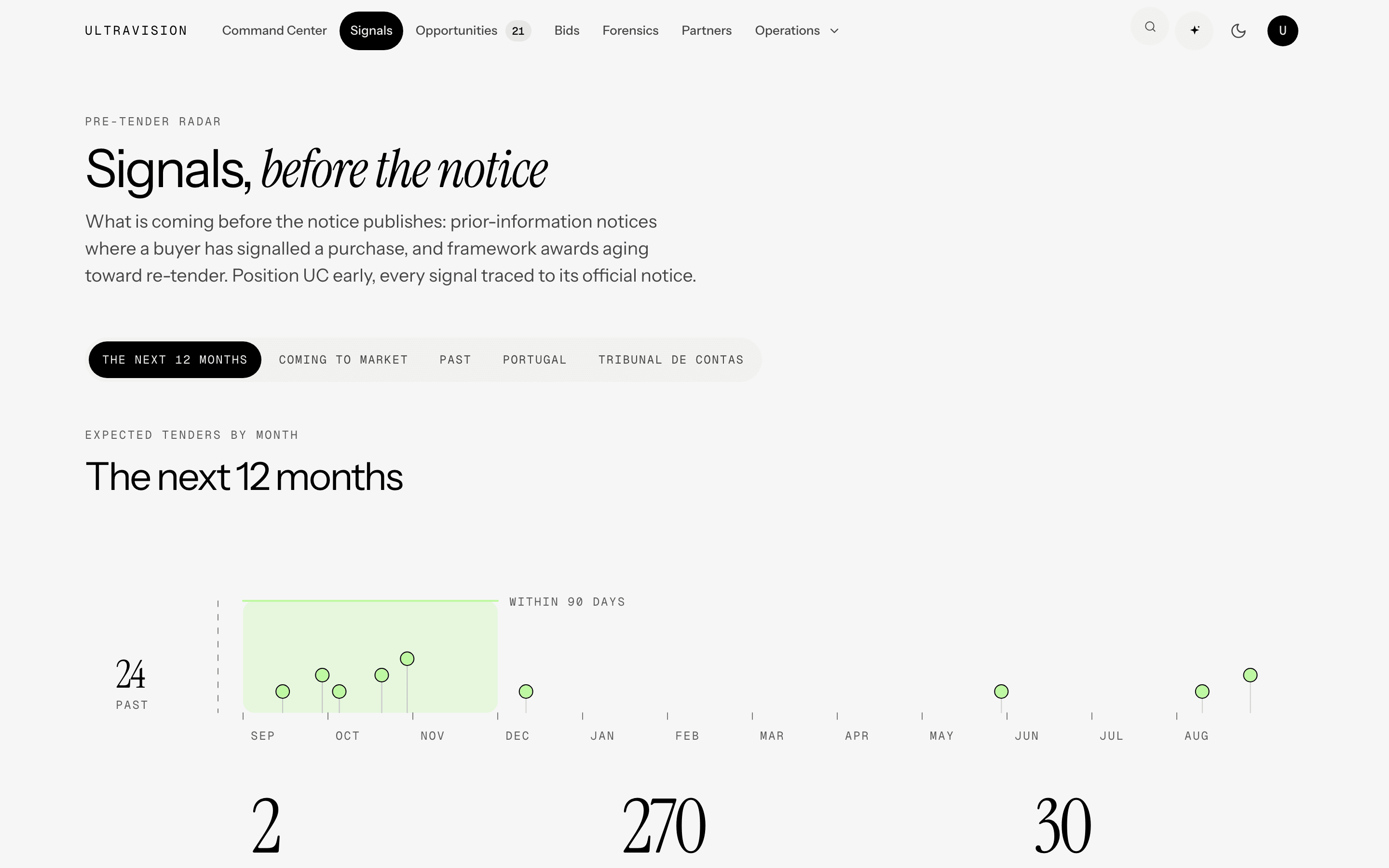 live workspace · signals
The pre-tender radar of the live workspace: planned procurement and requalification signals, each one linked to its official notice.
Explore the moduleLosing second place is not the end of the file.
Upload the procedure documents and the winner's proposal. A multi-lens legal and technical audit hunts grounds for exclusion, then an adversarial pass tries to refute every one, and only what survives reaches the report: the literal quote, the article it rests on, whether the defect can still be cured, and the filing deadline in working days. Run the same audit on your own bid before it goes out and every finding comes back as a vulnerability with the fix to make first.
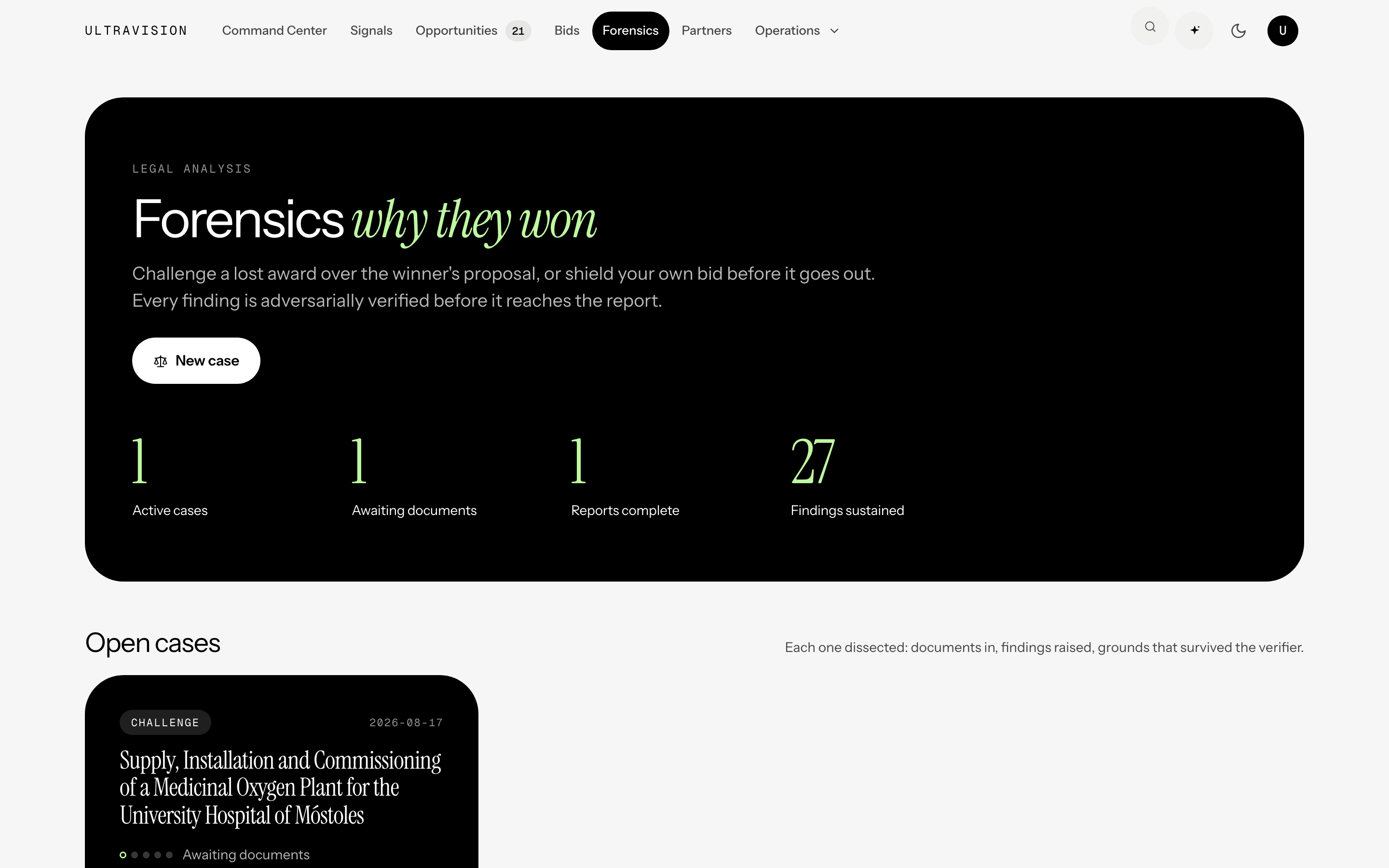 live workspace, forensics
Confirmed grounds on a real case, each one verified against the documents before it reaches the report.
Explore the modulelive workspace · command centerlive workspace · opportunitieslive workspace · tender viewlive workspace · signalslive workspace, forensicsThe newest client, unconnected to the founder, won two tenders its radar surfaced in month one: EUR 130,000 and EUR 60,000.
Every image on this page is an unretouched screenshot of the live platform, captured in September 2026 from the workspace TRINTA runs for Ultra Controlo, the founder's family company and first client. The tenders, scores, deadlines and counts are real records as they stood that day. Each client's radar runs under its own name and branding, which is why these screens read UltraVision: that is the name this workspace wears for that client.
The quiet capabilities.
Partners bench
A bench of the installers, distributors and local partners you bid with, tracked country by country, next to the tenders that need them.
12-status bid pipeline
Every bid moves through a twelve-status ladder, from first look to won or lost, with the outcome recorded to sharpen the next one.
WhatsApp and summary exports
Any tender leaves the workspace cleanly: a WhatsApp message for a colleague or a generated summary, one click from the tender page.
MCP server
Bring your pipeline into your own AI. Claude, or any MCP client, can query your workspace read-only with an API key.
Multi-language scanning
Sources are scanned in the languages buyers publish in, and the audit reads them all, so a strong fit in another language is still a strong fit.
Per-client branding
Your radar runs in its own workspace, under your name and your colours. The screens above carry our first client's.
See it with your tenders in it.
We configure a private radar around your catalogue and regions, then walk you through these exact screens live. Twenty minutes, your tenders, your fit scores.